"Tools and Everything for first responders including Federal Government, Municipality, Volunteer, Private contractors, Hazardous materials teams, structual Firefighters, wildland Firefighters and Rescue crews. Also articles on training and educational opportunities for the Fire Service, EMT, Rescue, disaster response. Please submit and comment on stories. Firefighting related Stories."

This site will focus on first responder safety equipment and gear including Fire fighting tools, personnel protective equipment, high angle gear, safety equipment anything and everything for first responders including Federal Government, Municipality, Volunteer, Private contractors, Hazardous materials teams, structual Firefighters, wildland Firefighters and Rescue crews. Also articles on training and educational opportunities for the Fire Service, EMT, Rescue, disaster response.
Showing posts with label Wildland. Show all posts

Wednesday, May 02, 2007

WHEEL CHOCKS - buy wheel chocks for a wildland water tender

picture cover NFPA 1906 wildland fire apparatus

Ok simple little task...
Acquire NFPA1906 compliant wheel chocks for a wildland fire tactical water tender.

What brands are wild land fire compliant? How do you know the specs?.
What is SAE J348? What is NFPA 1906?.
Solid bottom? 10% grade, 15% grade or 30% grade which is it? .
What is readily accessible?
Can I find a definition?.

So I start with NFPA 1906 Standard for wildland apparatus 2006 edition. Advertised as

Ensure that wildland fire apparatus are up to the task!

NFPA 1906 defines the requirements for a new automotive wildland fire apparatus, including apparatus equipped with a slip-on fire fighting module, designed primarily to support wildland fire suppression operations.

Finding the actual text online in the NFPA HANDBOOK dealing with wildland appuratus is difficult by design apparently. The NFPA sells the text in softback and PDF online but I do not need the whole thing just one section, just one sentence! They allow you to review it here. And eureka I found the actual text in the NFPA HANDBOOK !


picture text NFPA 1906 wildland fire apparatus


So this is the actual text in the 2006 NFPA Handbook 1906 12.2.1 minor equipment.


(1)*Two solid bottom wheel chocks, mounted in readily accessible locations, each designed to hold the apparatus when loaded to its GVWR, on a 10% percent grade with the transmission in neutral and the parking brake released.

I was unable to find out what the Astrix denotes... that is worrisome.
Cuts and snips from the internet:
Google search results for key words SAE J348 nfpa 1906 combined: Web Results 1 - 8 of 8 for SAE J348 nfpa 1906. (0.27 seconds)

Only eight results not much out there! And the third one really confuses things! It is a meeting minutes for a Fed R1 equipment committee.


Wheel Chocks: Spec/standards SAE J348 is flawed. Chocks.com has guideline on number of chocks required for various degrees of grade. Must comply with NFPA.

Basic requirements are that chock must be planed, solid (not officially out yet), with handle. Height depends on tire size – should be level with rim.

Rich Grady will follow up


Ok thats a bit confusing must be solid? but it is dated 12-02 so hopefully we can just ignore that anyhow moving on ...
so we will go to CHOCKS.COM and what do we find out?

Nice clean website but the search engine seems broken no returns on keyword nfpa 1906?

Ok so I look around and I find this quote on Chocks.com in the FAQ:


"Question: What is SAE J348 and what is its use.
Answer: SAE J348 is a standard set by the Society of Automotive Engineers that predicts the potential of any one wheel chock given a worst case scenario.


What the hell does that mean? that's it? At least give me a citation for that statement...

we will hopefully return to these questions


So we continue surfing chock.com

I like these chocks at chocks.com price is right they look sturdy and professional but are they compliant?

Model HGS molded aluminum


Drawing/Specifications Standard CAD Drawing">

Material:
Aluminum
Size: 7.75"H x 8.25"W x 12"L
Weight: 5.2 lbs.
Item No.: 12102
PDF: Catalog
Description

HGS is a heavy duty molded aluminum wheel chock with a heel-to-toe length that allows for a steeper line of force between axle and rear teeth, and therefore, a enhanced coefficient of friction. Hand-grab opening allows for fast placement and retrieval. Flanged base allows a full range of bracket options.

Commonly used on Loading docks, utility, and fire trucks.

Safety Data
Tire Size: Large "Standard" Tires
% Grade Rating: 16%
Best Use: Loading Docks. Utility, Fire, and Aerial
Features: Unbreakable Molded Aluminum Construction. High Adhesion and High Capacity.
I have learned the first thing I am looking for is a solid bottom which is required in NFPA 1906 for wildland fire fighting.
And this catalog description does not answer this question.

So I call them at chocks.com and get real person Doug on the line who tells me they are compliant and solid bottom chock known as a SBC and supplied a photosolid bottom chock


but suggested this chock the model HWC-7H


Model HWC-7H extruded aluminum
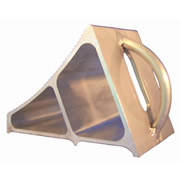

Drawing/Specifications HWC-7H Large Extruded Aluminum w handle CAD Drawing

Material:
Aluminum
Size: 8"H x 7"W x 11.8"L
Weight: 8 lbs.
Item No.: 11101155
PDF: Catalog
Description

HWC7H A heavy duty extruded aluminum chock that is well suited for medium to large tire use. This wheel chock has a light weight, serrated tire contact area for advanced tire traction and a solid bottom to resist soil compression. This wheel chock will not harm blacktop and is non-sparking.

The HWC7H features a welded aluminum handle for easy placement and retrieval

Commonly used on Wildland trucks and utility vehicles.

Safety Data
Tire Size: Large Tires
% Grade Rating: 17%
Test to Failure: Meets SAE standards (paired)
Best Use: General. Large-Tired Vehicles with Potential Off-Road Use.
Features: Extruded Aluminum Construction. Solid Bottom Aluminum Grab Handle. Resists Soil Compression.

Ok these are great looking, well designed, but we need to make sure they are compliant how?

Doug says they are!

They sure look great!

they are eight inches tall which should be good for my truck since the bottom of wheel rim to ground measures exactly eight inches.


to be continued..

Day 2...

Searching for information I find that the The City of Elko Nevada Fire Department specs these HWC7H wheel chocks... Sweet!
Specifications are for an Interface fire apparatus.

Next

Ok so I find this wheel chock discussion dated September 2004 on wildland fire.com


9/16 Wheel chocks:

NFPA Standard 1906 for Wildland Fire Apparatus
2 wheel chocks with solid bottoms
Each wheel chock must hold a fully loaded vehicle on a 15% slope
2 wheel chocks must hold a fully loaded vehicle on a 30% slope
Wheel
chocks must have a height as high as the bottom of the rims on the
truck that it will be used with
Wheel
chocks must have a solid bottom to prevent sinking in soft soil
Wheel
chock must have a face beveled at a 30-50 degree angle
Wheel
chock must be 2/3 as wide as the tire
Wheel
chock base must be 1.4 times the height or greater
Wheel
chock must have a heel behind the top tire contact point of the chock
as long as 1/2 the height of the wheel chock

The source of this information was the NRCG equipment inspectors workshop,

hope that helps.

MT Smokey


I wish Smokey had left some links to citations for this list I have no idea where this list officially came from we will ignore it for now

Day 3

Off to a yearly hired equipment refresher course more information sent to me will post next week...

This is my list as I learn more subject to change:

Requirements for Wildland Fire apparatus wheel chocks
  1. Two Chocks must be mounted and readily accessible.

  2. Chocks must be solid bottom.

  3. Chocks designed to hold the apparatus when loaded to its GVWR, on a 10% percent grade with the transmission in neutral and the parking brake released.
Note: Last year I was told by a Fed hired equipment / water tender inspector that they had to be metal so far no joy finding a reference to that requirement?


This will be a list of Wheel chock rules, do's and dont's:

NFPA standards require wheel chocks to be mounted on fire apparatus before being placed into service. Two Chocks must be mounted and readily accessible per NFPA 1901 (Section 7-2), 1902 (Section 7-2), 1903 (Section 6-1)
and 1906 (Section ?-?)
  • Wheel chocks should be placed in front of and behind the drive axle on the driver’s side of the vehicle or, in the case of a tandem axle, between the axles.


NFPA 1906, Standard for Wildland Fire Apparatus, was published in 1995 to provide a standard for apparatus that are designed and deployed to combat fires in wildland. The document covered apparatus with pumps ranging in size from 20 gpm to 250 gpm (76 L/min to 950 L/min) and water tanks with a capacity of 125 gal (473 L) or more.

Requirements were also provided for the first time for foam proportioning systems using Class A foam as a fire suppressant agent and for Compressed Air Foam Systems (CAFS). The apparatus covered in the standard included built-to-specification apparatus and fire-fighting packages designed to be slipped onto a vehicle chassis.

The 2001 edition updates the 1995 edition. The requirements for low-voltage electrical systems, including the emergency warning systems, have been moved to a separate chapter and brought in line with the requirements in NFPA 1901, Standard for Automotive Fire Apparatus. The pump chapter was reorganized to provide requirements for four types of pumps with the range of pump sizes changed to include pumps from 10 gpm (38 L/min) to 500 gpm (1900 L/min). The allowable minimum size on water tanks was lowered to 50 gal (190 L), and the chapter on line voltage systems was removed. The document was updated where appropriate to make the requirements consistent with those in NFPA 1901.

Thursday, December 28, 2006

Largest California wildfires at a glance

Del Puerto Canyon fire-By Robert O'Connor

Photo by Bob O'Connor Del Puerto Canyon Fire

Five largest wildfires in modern California history:

Cedar Fire, San Diego County, October 2003, 273,247 acres, 427
square miles.
Matilija Fire, Ventura County, September 1932, 220,000 acres,
343 square miles.
Marble Cone Fire, Monterey County, July 1977, 177,866 acres, 278
square miles.
Laguna Fire, San Diego County, September 1970, 175,425 acres,
274 square miles.
Day Fire, Ventura County, September 2006, 162,702 acres, 254
square miles.
---
Source: California Department of Forestry and Fire Protection.
The CDF does not list fires prior to 1932 because records are
unreliable.

Study Links Wildfires to Ocean Temperatures


By JEFF BARNARD
Associated Press Writer


Using fire scars on nearly 5,000 tree stumps dating back 450 years, scientists have found that extended periods of major wildfires in the West occurred when the North Atlantic Ocean was going through periodic warming.

With the North Atlantic at the start of a recurring warming period that typically lasts 20 to 60 years, the West could be in for an extended period of multiple fires on the scale of those seen in 2002 and 2006, said Thomas W. Swetnam. He's the director of the Laboratory of Tree Ring Research at the University of Arizona and a co-author of the study published in the Dec. 26 issue of the Proceedings of the National Academy of Sciences.

"This study and others have demonstrated that there is an underlying climatic influence on fuels and then on the weather conditions that promote fires," said Dan Cayan, climate researcher at the Scripps Institution of Oceanography, who did not take part in the study.

Ron Neilson, a U.S. Forest Service scientist who has developed models that predict wildfire danger based on climate models, agreed with the study's conclusions, and noted all the oceans are affected by global warming. And that in turn could exacerbate the wildfire cycle.

Scientists have long seen a relationship between weather in the United States and El Nino, a warming of water in the South Pacific.

When El Nino is strong, the Northwest typically has drought and severe fire seasons, and the Southwest has rain. When the cycle reverses, known as La Nina, the South Pacific cools, the Northwest has more rain, and the Southwest has drought and fires.

Less well understood are two other climate drivers, the Pacific Decadal Oscillation, known as the PDO, centered in the North Pacific, which typically changes every 10 to 20 years, and the Atlantic Multidecadal Oscillation, or AMO, which is marked by warming and cooling periods of 20 to 60 years in the North Atlantic.

El Nino-La Nina is thought to be the most influential cycle, but the Atlantic and Pacific oscillations can magnify or diminish those effects when strong phases of the three cycles come together, Swetnam said.

"Over the last 400-plus years in our fire history study, when the AMO was positive (producing warm temperatures in the North Atlantic), then you would get big fires breaking out synchronously across the West," Swetnam said. "That's what we saw in 2002 and 2006."

The year 2002 saw three huge fires that stretched firefighting resources to the breaking point: Biscuit burned 500,000 acres in southwestern Oregon, Rodeo-Chedeski burned 462,000 acres in Arizona, and the Hayman fire burned 136,000 acres in Colorado.

In 2006, 89,000 fires burned across 9.5 million acres. The U.S. Forest Service spent $1.5 billion fighting those fires - about $100 million over budget.

Another factor in the larger fires, said Swetnam, is that after a century of fighting wildfires, fuel is building up in the nation's forests.

The study gathered data from 241 logging sites around the West, compiling the dates of 33,795 fire scars on 4,700 stumps to develop a history of fires in the West dating to 1550.

The fire history was compared to a reconstruction of the Atlantic Decadal Oscillation, the Pacific Decadal Oscillation, and El Nino.

The most severe fire seasons fell between 1660 and 1710, when the Atlantic Multidecadal Oscillation was at its warmest, the study found. The least severe fire seasons happened from 1787 to 1849, when North Atlantic temperatures were at their coolest.

The study comes after another published this year in the journal Science found that a sudden and dramatic increase in western wildfires in the late 1980s was related to a pattern of earlier springs and warmer summers. Swetnam and Cayan both took part in that study.

Greg McCabe, a climatologist for the U.S. Geological Survey in Denver, said his research has been showing a connection between North Atlantic Ocean temperatures and the drought that is gripping much of the West, which creates conditions for major fires.

"I think what Tom has written is really good," McCabe said. "More and more people are starting to see there is something there. We do know the tropical Pacific (home to the ocean warming condition known as El Nino) is a key player in global climate. But on longer time scales it looks like the Atlantic also has some influence."

Tuesday, December 19, 2006

The good the bad and the ugly - Water Tenders


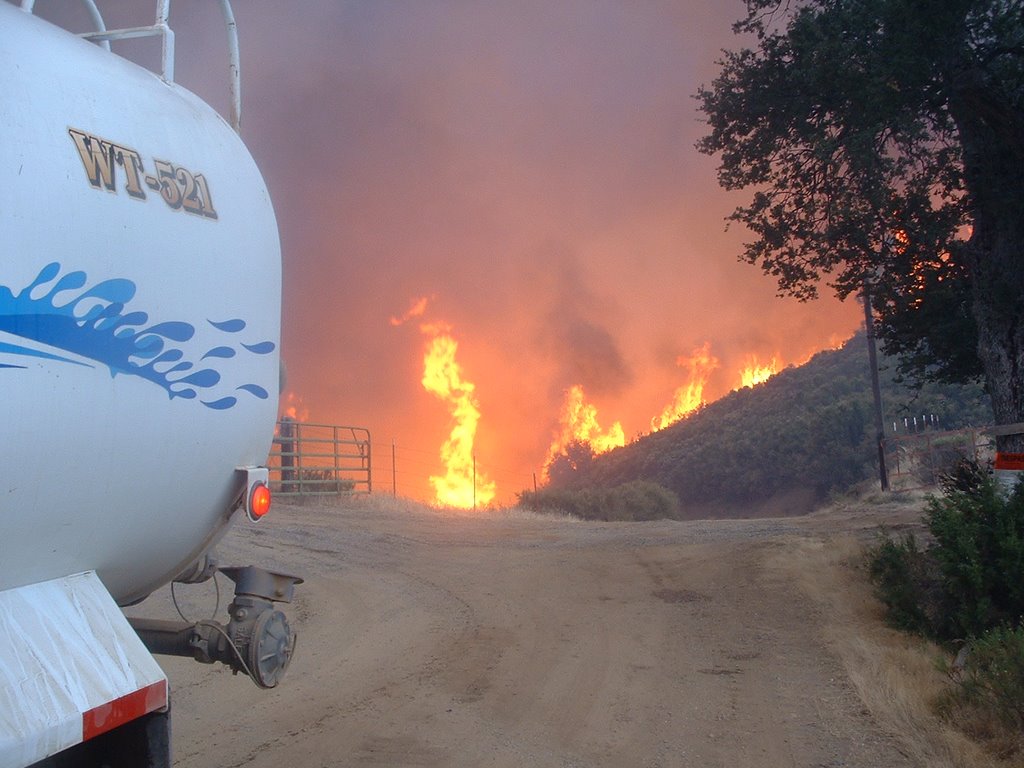
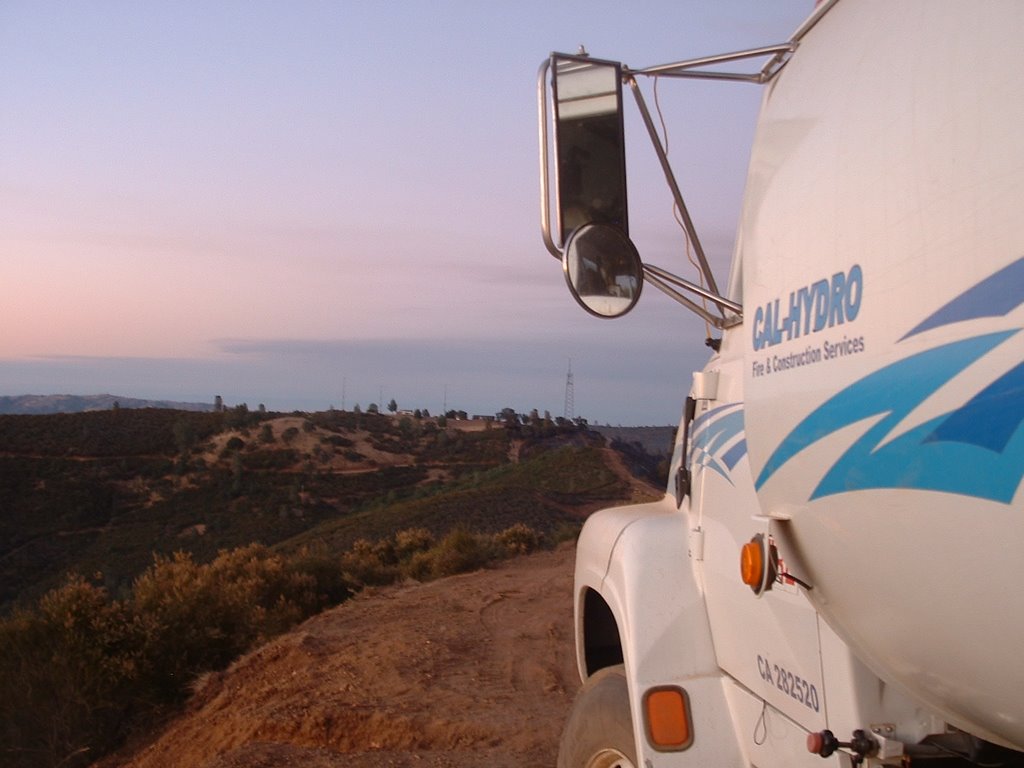
In the west they are called "water tenders" out east "water tankers" to the general public they are "water trucks" either way they bring water to areas without a sufficient water supply to fight a fire.

The California Department of Forestry (CDF) now officially known as "CalFire", The United States Forest Service (USFS) and other cooperators such as Bureau of Land Management (BLM), depend on these vehicles to fight fires in areas with limited or no water supplies.

Google
 

This site will focus on first responder safety equipment and gear including Fire fighting tools, personnel protective equipment, high angle gear, safety equipment anything and everything for first responders including Federal Government, Municipality, Volunteer, Private contractors, Hazardous materials teams, structual Firefighters, wildland Firefighters and Rescue crews. Also articles on training and educational opportunities for the Fire Service, EMT, Rescue, disaster response.